Category: Uncategorized

  • 100 days of democracy, day 96: thoughts on 4 books and multiparty politics

    Long time no see! After feeling paralyzed for the first 100 days of Trump’s second term, I launched the “100 days of democracy” series to spur myself towards more constructive efforts for the second hundred days. As we near the 200th day of the term on August 8th, I haven’t written as much as I expected to, nor been as action-oriented as I intended, but I’ve done a lot of reading and thinking, and I’m nearing some more tangible ideas that I want to flesh out more in the next 100 days. I’d like to update you on that journey.

    Since my last post on day 13, I’ve read four books that have given me a foundation for thinking about the past, present, and future of American democracy: 

    • How Democracies Die (Steven Levitsky and Daniel Ziblatt, 2018)
    • Abundance: How We Build a Better Future (Ezra Klein & Derek Thompson, 2025)
    • Why We’re Polarized (Ezra Klein, 2020)
    • Breaking the Two-Party Doom Loop: The Case for Multiparty Democracy in America (Lee Drutman, 2020)

    How Democracies Die taught me that democracies have been upheld throughout history by norms of mutual toleration (seeing political opponents as rivals rather than enemies) and forbearance (leaders deliberately holding back from leveraging all the power at their disposal). It also taught me that modern democracies don’t usually collapse into full-blown totalitarianism but rather into “competitive authoritarianism” in which elections still happen but liberties are suppressed. As norms of mutual toleration are widely being eroded, and leaders are exercising less and less forbearance, alongside increasingly overt corruption and constitutional showdowns between the executive branch and the judiciary, it’s not hard to imagine the US potentially sliding into competitive authoritarianism in the years ahead, though we do still have some fairly robust structural protections keeping us afloat. 

    One of the more perspective-changing parts of the book was the emphasis on political parties as gatekeepers to power and bulwarks against populism. Before the modern primary election system started in 1972, party insiders had much more control over who would be chosen as the nominee. While these “smoke-filled rooms” were susceptible to corruption and limited voters’ power, they also tended to produce more moderate candidates and prevented more radical or populist leaders from rising to power. This theme reappeared in Why We’re Polarized and Breaking the Two-Party Doom Loop: political parties are key institutions in our democracy for preventing the rise of authoritarian leaders, and for mediating politics for the public – giving voters a home where they can trust their values and preferences generally to be represented in policy ideas. I finished How Democracies Die with a more nuanced appreciation for parties, and with a recognition that we must bolster our longstanding traditions of mutual toleration and forbearance in order to prevent democratic backsliding. 

    I next moved on to Abundance, mostly because it seemed like everyone was talking about it, and it turned out to be a hopeful palate cleanser. It helped me realize the way that the Democrats, as the pro-government party, have become defenders of regulation in ways that hinder progress toward a more abundant future. It helped me feel more excited about a vision for the future where we use the levers of government to build and innovate. But, while I felt optimistic about abundance politics as a new vision and message for the Democratic party, I didn’t feel like it would be enough to set our country back on track. I needed to understand more about what’s at the root of our toxic politics.

    I decided to stay with Ezra Klein and read his 2020 book, Why We’re Polarized. This was a great journey into the history and present state of polarization in America. I learned that it wasn’t long ago when many felt that the country needed more polarization. In 1950, the American Political Science Association published “Toward a More Responsible Two-Party System,” urging the Democratic and Republican parties to distinguish themselves in order to offer citizens clearer alternatives. Incoherent and ideologically overlapping parties abdicate their responsibility to help voters understand the issues at play and potential policy choices. We certainly no longer suffer from this lack of party distinction.

    Another key cleavage came with civil rights. Up until then, our two-party system had actually masked a four-party system, with conservative southern Democrats and liberal Republicans making up their parties’ coalitions. After civil rights, the parties realigned with conservative southerners joining the Republicans and liberals joining the Democrats. Thus ensued what Klein describes as “identity stacking,” with core identities like race and religion aligning tightly with political parties. The amount of cross-cutting identities dwindled, and now the amount of Democrats and Republicans who prefer their child to marry someone of the same party has doubled, to 60%. 

    Beyond identity stacking, we’ve also seen many more years of divided government, in which congressional leadership are incentivized to obstruct the president’s agenda, in hopes that their party will win the next presidential election. As each party has adopted more hostile tactics, the other has responded in turn, making each election feel like an existential threat to people on either side. Informed by Klein’s thorough historical analysis of polarization, I went in search of solutions.

    I am so grateful to have found Lee Drutman’s 2020 book, Breaking the Two-Party Doom Loop: The Case for Multiparty Democracy in America. For the first time since starting this blog, I feel like there’s a viable way out of our national quagmire, even if it’s incredibly daunting. I recommend that everyone read this book. Drutman starts by laying out the self-reinforcing “doom loop” of our current two-party politics, and convincingly makes the case that we are headed for destruction if we don’t get out of the two-party system. As a person living in 2025, who has read everything above, I am fully on board and am not going to go into more detail of those arguments.

    What was new for me was the analysis of why multiparty democracy is superior and has worked so well elsewhere. Having multiple parties (ideally 5ish) undermines the identity stacking driving the wedge in the two-party system and forces collaboration. It erodes the sense that your party must win a majority in the next election or else the country is doomed. While it’s true that most of our best examples of multiparty democracy come from parliamentary systems in Europe, where the majority coalition in the legislature chooses the executive, he makes a strong case that the same principles apply and are likely to work in the US presidential system as well. 

    Besides a multiparty system, the only alternative I can imagine that might revive American democracy, would be a major party realignment which breaks the identity stacking. But I just don’t see that happening anytime soon, because of the “doom loop” phenomenon that is driving everyone deeper into their corners. And shaking up the core platforms of two major parties wouldn’t change the fundamental problem that the minority party is incentivized to obstruct the majority party, forcing the majority party to be more aggressive when in power, and undermining the key norms of mutual tolerance and forbearance.

    So this is where I’ve landed after (nearly) 100 days of democracy. I’m convinced that our democracy is at risk. I’m convinced that we’re in a two party doom loop of toxic politics, and that multiparty democracy is the best way out. Even though I wrote less than I expected, I learned more than I expected in these 100 days. I was pleasantly surprised to have the blog spark conversations with friends and push my thinking in new directions. Overall it was successful enough that I’m going to keep it going. I’ll call this next phase Another 100 days of democracy: exploring multiparty politics. Hope you’ll join for that journey! 
  • Guest blog: from a current, former, fired, rehired, confused federal worker

    In my first job interview after getting a Masters in Public Health and completing Peace Corps service, the interviewer said: “We sure don’t get into Public Health for the money!”

    We all laughed, assured that our salaries were far too small to be on a budget chopping block. 

    During Donald’s first term, he put a hiring freeze on CDC, ostracized the WHO, and set us up for failure during the COVID-19 pandemic. Thanks to decades of taxpayer funded research into vaccines and a change in administration, we had the power to combat the pandemic and to save lives when I joined CDC in 2021.

    Over 4 years with CDC, I worked on COVID-19, TB, Mpox, and HIV. It feels like all of that work, and the progress that was made, has been burned to the ground since January 2025. 

    On April 1, 2025 – April Fools’ Day (I guess we were fools for believing this would all be okay) – I received my Reduction in Force notice. My whole HIV prevention branch, my boss and my boss’s boss, and a large number of health communicators were impacted.

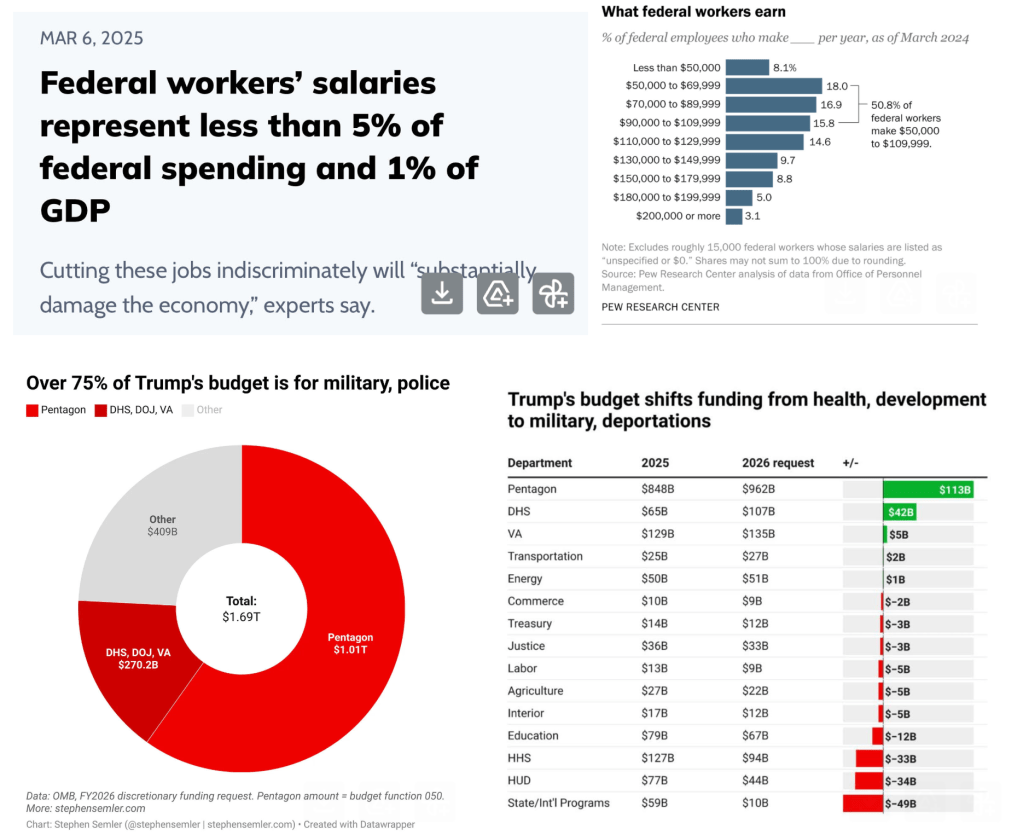
    This has all been in the name of “government efficiency” – what a joke. Our federal salaries and lifesaving programs are a drop in the ocean of the federal budget. Public Health is already very effective at saving taxpayer dollars! “An ounce of prevention is worth a pound of cure” – meaning, $1 invested in Public Health yields improved health outcomes equivalent to as much as $88 saved in healthcare costs. A few stats:

    • 0.17% – In FY 2024, the total CDC budget was 0.17% of the federal budget (proposed to be cut in half for FY 2026)
    • 5% – All federal workers’ salaries represent less than 5% of federal spending
    • 50% of federal workers make between $50,000 and $110,000 a year
    • 75% of the proposed FY 2026 budget is for military and police

    These cuts to public health and healthcare will kill people and will be felt for generations to come.

    So why would they target health communicators at CDC? I have two theories – one is that they don’t respect verified health information. The “do your own research” crew can just use Facebook to find justification for their own beliefs. We were tasked with digesting complex health research and boiling those down to actionable and easy-to-understand messages for the general public and healthcare providers. Those people are now gone, leaving millions without evidence-based health information.

    My second theory is that they actively prefer to have an uninformed and misinformed voter base. If no one communicates health information and statistics, they can continue to lie about our civic duty to protect each other from disease. The ongoing measles outbreak and lack of government response is a perfect example.

    Thanks to checks and balances, a federal judge has indefinitely paused the sweeping overhaul of the federal government. Due to the work of labor unions, nonprofit organizations, and local governments, the administration must now either roll back these changes or seek another opinion from a different court. This is great news for us, but damage to the public trust of government institutions is already done.

    The fight for public health and health equity will be a lifelong one. But for the next few years, we can look to our families, our communities, and our cities to help us stay healthy. We should not waver in the demand for safe and healthy communities as well as for evidence-based health information. Love each other, protect each other, and get vaccinated! 

  • 100 days of democracy, day 13: Sacramento, and some good reading

    Hey there, it’s been a while! Have been doing lots of talking, reading, and taking action in the meantime.

    First up, Sacramento. I was there last week with internal medicine residents from across the state. I met with aides to our local Asm. Haney, Sen. Wiener, and also Sen. Dahle who is a Republican representing a lot of northern California. As I waited in long lines to get through security into the building (literally around the block!), I reflected on what a tremendous privilege of democracy it is that any citizen can walk into the legislature and have the ear of their representative. Yes, we had appointments, but I could just as easily have wandered in off the street and entered the office of any legislator. In every corner of the building I saw ordinary people there to make their case on issues ranging from microplastics to religious freedom. I left the capitol feeling inspired by the hundreds of my fellow citizens who believed in our democracy enough to go make their voices heard in the state’s capitol.

    Since then, I’ve been doing some reading. Thanks to my mom for sending me ‘At this point, we are a liberal democracy in decline’: A conversation with scholar Larry Diamond about the state of U.S. democracy (Washington Post). This helped me understand the distinction between some key features of democracy, namely (1) liberalism/freedom, versus (2) elections. You can have elections with suppression of freedoms in between. Diamond argues that this is where we’re headed — we’re clearly still an electoral democracy, but with a decline in liberties.

    That article led me to “Is it happening here?” in the New Yorker. This piece, drawing heavily from the 2018 book “How Democracies Die” (by Steven Levitsky and Daniel Ziblatt) (which I have also started audiobooking), talks about how modern-day authoritarianism is much more insidious than the violent coups of the past. They share how countries like Hungary have eroded democratic norms and suppressed freedoms while still holding elections and maintaining the shell of democracy, even while the insides are hollowed out. (note that I haven’t finished this piece yet but will update with more reflections in the next blog!)

    My takeaway from all this is both a deepened gratitude for our democracy and a heightened fear that we can go deep down an autocratic path before most of the public sounds the alarm, because an illiberal electoral democracy can camouflage as a real democracy for a long time.

    The Diamond interview in WaPo makes one important point — in several countries that suffered backsliding and then recovered their liberal democracy, they still were hampered by intense political polarization that impeded progress. I think we are at high risk for this. Even if Democrats take back the House in 2026 and the presidency in 2028, we may still be headed down a dark road unless we can unite the country.

    Just more motivation to build a true pro-democracy movement. Hope to continue building towards that in the next 87 days of this journey.

  • 100 days of democracy, day 6: some readings and thoughts on next steps

    I’ve been in San Diego this weekend, heading to Sacramento for two days of advocacy and lobbying with resident physicians from across the state. Looking forward to some democracy updates from there!

    On the flight to San Diego I read some interesting stuff:

    1. American kids are getting worse at civics: https://www.nationsreportcard.gov/highlights/civics/2022/ (thanks Clara for sending!)
    2. Adult American knowledge of civics/government is also abysmal: https://www.annenbergpublicpolicycenter.org/political-communication/civics-knowledge-survey/
    3. The Brookings Institution has a great democracy playbook and series of articles on monitoring the pillars of democracy under Trump. They outline 7 pillars to defend democracy:

    I’ve been really flattered this weekend to hear from several folks who have been reading the blog. I’ll try to keep it interesting for readers, but just a reminder that this is mostly a mechanism to hold myself accountable. I do hope to build toward something meaningful through this, though.

    On that note, I have been continuing to reflect on what union-style organizing for democracy in America might look like. I think I’d need to start with a team representing different regions of the country. I’d like for this to be ideologically diverse. So, if anyone knows some conservative-leaning folks from different parts of the country who want to support democracy, hit me up! Or if you’re interested in being part of something in general, I’d love to talk.

    -AM

  • 100 days of democracy, day 3: America needs a union

    Since writing yesterday’s post, my gears have been turning about whether union-style organizing may be the strongest example of real democracy. Beyond unions’ commitment to majority action, they also build grassroots power which lends strength to the people’s voice. I ended yesterday’s post wondering about whether this approach could be scalable at a national level. Can you essentially unionize the American people to uplift the public will to government? In some ways it feels like reinventing government, or political parties, but in another it feels like it could be an important counterweight to those forces that elevates the people’s will far better than our government or parties currently do.

    I thought it would be cool to call this “The People’s Union,” but it turns out this name is already taken by this group that seems focused on boycotting corporations through “economic blackouts.” The founder, John Schwarz, has 427k followers on Instagram, so there’s some traction there, but I don’t really align on the strategy or aims.

    Whenever I get a big crazy idea, I try to imagine it on a more manageable scale. I’ve been thinking about what it would take to organize my zip code. Could a 94107 union advocate for our collective best interests? What would we even ask for? How would we possibly go about organizing the 34,000 people in the area?

    I’d like to think that there would be real value there, but it also feels daunting. I don’t even know what I myself would ask for/ try to achieve. But, then again, the first step of organizing is about connecting on shared values. I know very clearly what’s important to me, and I think many others do as well. There may be intrinsic value to this, even if the goal isn’t to move toward any particular action. Time to get to know my neighbors!

  • 100 days of democracy, day 2: Happy May Day!

    Today is May Day, an international celebration of organized labor and the working class. Today, labor unions at UCSF went on strike, and unions led rallies across California. During my “100 days of democracy” I plan to participate in more rallies, protests, and other forms of pro-democracy organizing, but unfortunately today I was in clinic so couldn’t make it to the SF May Day rally. So, instead, I’ll take some time to write.

    Coincidentally, I co-facilitated a session this week about workplace organizing, which reignited my appreciation for the democratic principles underpinning labor organizing. One of the core values that I was taught as a leader in my union was the power of majorities. The goal was always to engage a majority of our colleagues, because there is nothing more democratic (and more threatening to management) than majority participation in action.

    When this is done right, it can be truly democratic. I helped lead a few campaigns that engaged a majority of our bargaining unit. It is a powerful feeling to know that you have a true, democratic majority on your side.

    I also participated in smaller efforts that didn’t feel as democratic — where I felt that our leaders were farther to the left than our rank-and-file, and maybe those members who disagreed just didn’t feel strongly enough to push back on it. In the practical day-to-day, it’s very easy for leaders to slide out of step with the “people’s will” — something that is ever-changing, hard to measure, and won’t always come back to get you if you defy it. This isn’t true just in unions but in all sorts of organizations and levels of government.

    As a organization fundamentally committed to democracy, our union had a lot of conversations about how to represent the people’s will. In bargaining a contract, how do we assess the interests of 1,500 members? One might initially reach for a survey — surely a questonnaire that everyone has an equal chance to answer is a fundamentally democratic choice? But what about those who inevitably don’t fill out the survey, either because they don’t have time or don’t feel strongly enough? Are they no longer counted in the people’s will? And what about those who might answer one way on a survey, but if you talk to them individually and explain the arguments in more detail, they might change their minds?

    We ultimately chose a hybrid model — we did give everyone a chance to respond to a survey, but we also had extensive 1:1 conversations with members across different disciplines in order to better understand the values underpinning their responses. Because, in the midst of a negotiation, it’s much more helpful to know what people value, rather than to know what specific policies they wanted at a single point in time before the negotiation. Democracy is messy; there’s no single perfect methodology.

    As I’ve recently learned more about deliberative democracy, I wonder if this paradigm might have been another approach that could have helped us in our union organizing. What if we pulled a random sample of members and led them through a deliberative process prior to (or concurrent with) bargaining to get a more representative sample of members’ values and preferences? This might have helped us more accurately assess the people’s will, but it would have missed out on opportunities for power-building through 1:1 conversations.

    Any organization can operate more like a union — to commit to understanding, representing, and advancing the people’s will, and to engaging a majority of members in action. This week, my clinic decided to democratize planning for breast cancer screening by involving all our staff in the brainstorming. It resulted in an explosion of creative ideas! Now, the real challenge is to keep it democratic. It’s easy to involve everyone in brainstorming, but much harder to maintain democracy in implementation. To succeed, we’ll need to borrow strategies from the union — 1:1 conversations with a representative group of staff to understand their values and preferences, and maintaining those relationships through implementation. Alternatively, we could try a deliberative strategy, pulling a random sample of clinic staff to help guide the implementation. Just as with the union example, this might give a similar set of ideas but misses out on a lot of potential relationship-building.

    My takeaway here is that union organizing captures a democratic principle that is missed in deliberative democracy, and which I haven’t seen articulated in the (limited) amount of democratic theory I’ve read recently. The power of a network of 1:1 relationships is not just to capture the people’s will (which it can do quite effectively), but also to empower the people in implementation.

    Concluding question(s): How could an organizing approach to democracy be applied to uplifting the people’s will at a national level? Union density is too low, and party polarization is too high (also, political parties are not particularly strong at organizing), so it’s not clear that any single organization or network of orgs is poised to do this. Could a “Dems for Democracy” approach push the Democratic party to organize even among Republicans to uplift the will of all the American people?

  • 100 days of democracy

    Historians may look back on the first 100 days of Trump’s second term as some of the one of the most rapid periods of authoritarian backslide in American history. It has happened so fast that many of us have felt paralyzed, unsure how to respond. To be honest, I still feel this way. But, I’ve decided that I’m not going to sit on my hands for another 100 days.

    For the next 100 days, I am going to try to speak up, share my ideas, and advocate for a strong American democracy. I may not have time to do something or post something every day, but I’ll try my best. I’m starting by posting this blog, which has been a place for me to hash out some thoughts on democracy over the last several weeks. Nothing is finely polished, and nothing will be. But I hope these posts can be a jumping off point for dialogue and maybe inspire others to stand up for our democracy as well. Not just for the way our democracy used to be, but for something better.

  • About this page

    Our country cannot reverse the backslide into authoritarianism without a strong pro-democracy movement. In fact, we need a resounding win for democracy in the 2026 midterms and 2028 presidential election.

    A pro-democracy movement is also an answer to our current paralysis. In the midst of a constitutional crisis with the executive branch openly denying due process and defying the courts, there has not been a proportionate popular response. One of the factors is that a Democratic party grounded in political ideology is ill-equipped to rally its members around democratic issues such as due process.

    The goal of this site is to push Democrats and the Democratic party to prioritize and practice real democracy while fighting the myriad other ideological and constitutional fights happening right now. Because we cannot claw our way out of authoritarianism without a strong pro-democracy movement. And there is nothing stopping the Democratic party from going out and modeling real democracy for the country right now. We can run deliberative polls and citzens assemblies to find out what the country really thinks about due process and scientific research and the Department of Education. We can, and should, have these discussions out in the open among ordinary citizens.

    Importantly, the Democrats should be prepared to adopt the popular will as its own platform. If we believe in democracy, then we should practice what we preach. Empower the people to make decisions, and commit to the outcome. That’s how we build back real democracy in this country, and how we can deliver a resounding win for democracy in the years ahead.

    I hope you’ll engage with this site — leave comments, share ideas and feedback, and help us build a coherent pro-democracy strategy for the Democratic party. Our future depends on it.

  • “This is what democracy looks like”

    A common chant at protests is the call-and-response “show me what democracy looks like” // “this is what democracy looks like!” It speaks to one of the core principles of democracy, which is the ability of individuals to have their voices heard in government. But if I were to design a democracy from scratch, I wouldn’t say that mass protests are a gleaming example of what democracy looks like. In fact, they’re often a sign that democracy has broken down — an effort either to make government respond when ignoring the people’s will (such as in protests for gun control which is overwhelmingly popular but rarely enacted), or to make government respond to the interests of a faction that doesn’t represent the people’s will (such as defunding the police, which is quite unpopular in the country overall).

    This has prompted me to reflect on what democracy actually looks like. It doesn’t feel like our system — of elected representatives from two warring parties fighting for narrow majorities to unravel the other party’s agenda — has been getting it exactly right lately, even before many norms were tossed out the window in 2025.

    But what exactly is democracy? Wikipedia says that “[t]he term appeared in the 5th century BC in Greek city-states, notably Classical Athens, to mean “rule of the people”, in contrast to aristocracy … meaning “rule of an elite.” But a lot of modern day definitions have collapsed the concept of democracy into representative democracy, such as this one from Merriam-Webster: “a form of government in which the people elect representatives to make decisions, policies, laws, etc. according to law.” There’s clearly a lot of gray area here, and it’s not hard to argue that we have actually been living in an elected aristocracy rather than a democracy (which would explain Congress’ terrible approval rating).

    What else can “rule of the people” look like? Beyond representative democracy, there is also direct democracy (which we practice in California when we vote on many ballot propositions each election). But, direct democracy is impractical. Ordinary people (myself included) don’t have the time to gain the necessary expertise on so many topics in order to cast well-informed votes. And, voter turnout is already nowhere near 100%, meaning that outcomes are not reflective of the people’s will but rather the will of the people who voted.

    The most robust evidence supports deliberative democracy, in which representative sample groups (often called “mini-publics”) are brought together with experts and facilitators to discuss important issues. Specific techniques include deliberative polling and citizens’ assemblies. These have shown remarkable results in the US and across the world, proving that citzens in deliberative mini-publics can inform themselves on nuanced topics, change their opinions, generate new ideas, reach consensus, and deliver outcomes that are satisfactory to the overall public (i.e. truly representative).

    A great example of this was “America in One Room” – a 2019 deliberative poll which took a representative sample of 526 American voters and brought them together to discuss the big issues of the time. There were of course many disagreements, but overall they were able to moderate their opinions and find common ground.

    This is what democracy looks like. Ordinary people, getting together, with the time and information they need to develop informed opinions. They will argue and disagree but ultimately come out stronger, with results reflecting the thinking of the country. At a time when American democracy is in unprecedented peril, we need to reflect on what kind of a democracy we actually want for ourselves, and start building it. Yes, I will take to the streets and protest the undermining of our national values and governing principles, but from now on, when we say “show me what democacy looks like,” I urge us to respond more creatively.